

Page Contents
- Why Most People Build Income Backwards
- What the Passive Income Pyramid Actually Looks Like
- Practical Strategies to Start Building Your Pyramid
- The Mistakes That Collapse the Pyramid
- The Mindset That Holds the Pyramid Together
- The Long Game: Why the Pyramid Compounds Over Time
- Frequently Asked Questions
- Build the Foundation. Trust the Layers. Win the Long Game.
I remember the exact moment it clicked for me.
It wasn’t during some financial seminar or while reading a bestselling money book.So it was a Tuesday morning. It was ordinary. I checked my phone before getting out of bed. I noticed that money had come in overnight. Not from a shift worked. Not from an invoice sent. Just… there. Quietly deposited while I slept.
That moment doesn’t happen by accident. It happens because of decisions made months or years earlier. Decisions most people keep putting off because the results feel too distant, too uncertain, or too complicated to start.
The passive income pyramid is the framework that made those decisions make sense to me. And it might be the clearest mental model for wealth building that most people have never been shown.
Why Most People Build Income Backwards
Here’s something most people underestimate: the way the average person builds income is almost perfectly backwards. They start at the top — high-effort, high-maintenance income sources like freelancing, side hustles, or speculative investments — without ever building the stable foundation underneath.
It’s like constructing a building from the roof down. Exciting in theory. Structurally unstable in practice.

The passive income pyramid flips this. It starts with the base — the slow, unsexy, foundational layers of income that ask the most of you upfront and the least of you over time. Then it builds upward into increasingly active, higher-yield streams only after that foundation is solid.
This is the architecture of financial independence. And the people who achieve it aren’t usually the ones who found the hottest opportunity. They’re the ones who built in the right order.
What the Passive Income Pyramid Actually Looks Like
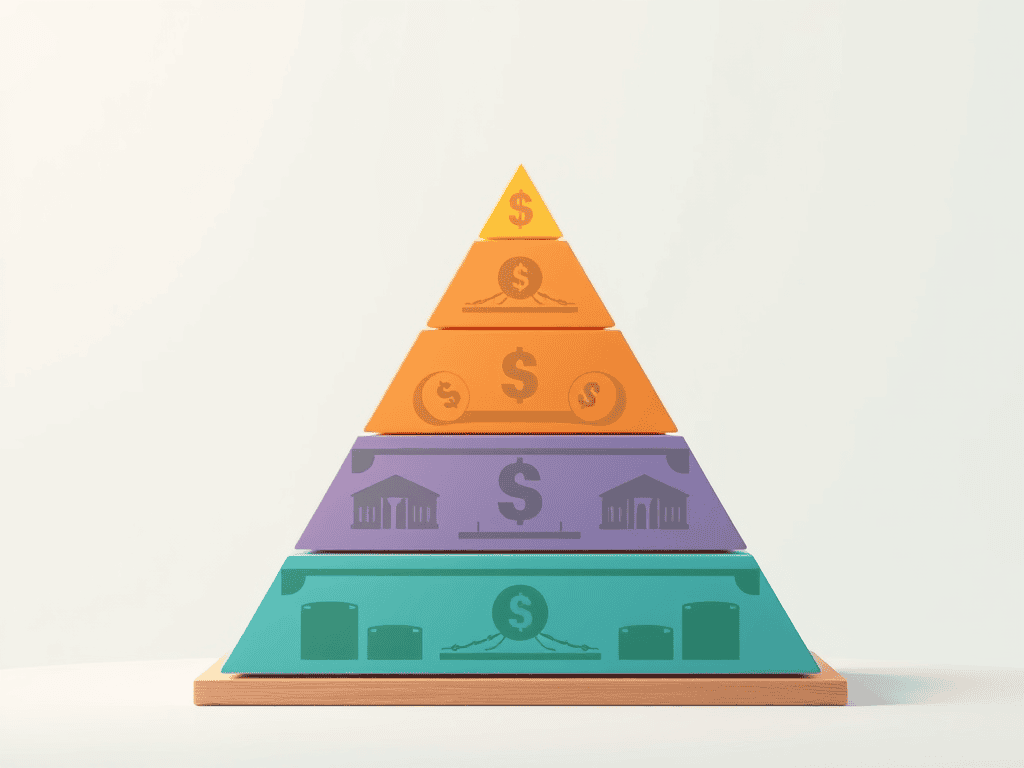
Think of the pyramid in three distinct layers, each one sitting on top of the last.
The Base: Security and Stability
This is where everything starts. The base of the passive income pyramid is your financial foundation — an emergency fund, debt-free living, and low-risk income streams like high-yield savings accounts, treasury bonds, or dividend-paying index funds.
These aren’t glamorous. They won’t make anyone rich quickly. But they do something more important: they protect everything above them. When the base is solid, you can take smarter risks higher up without risking collapse.
A mistake I see often is people skipping this layer entirely because the returns feel too small. Three percent interest doesn’t feel exciting. But three percent on a growing balance, held consistently over ten years, becomes something entirely different.
The Middle: Growing Streams
This is where the real momentum builds. Once the base is secure, you begin layering in income streams that require more upfront investment — of money, time, or both — but generate returns that scale beyond your direct effort.
Real estate rental income sits here for many people. So do dividend portfolios built over years of reinvestment. So does the income from a digital product, a course, or a piece of content created once that continues generating revenue long after the work is done.
The middle of the passive income pyramid rewards patience. These streams take time to establish. They often feel slow and invisible in the early years. But this is exactly where compounding begins to show its face — quietly at first, then unmistakably.
The Top: High-Yield, Higher-Risk
The top of the pyramid is where most people want to start. Angel investing. Business equity. Higher-risk asset classes with asymmetric upside.
Here’s the thing — these can be extraordinary wealth builders. But only when they’re sitting on a pyramid that can support them. Without the base and middle layers generating reliable income below, a single bad bet at the top can unravel everything.
This is where investment strategies get interesting, and where financial mindset matters most. The top of the pyramid is not where you gamble. It’s where you take calculated risks with money you’ve already earned and protected through the layers below.
Practical Strategies to Start Building Your Pyramid
You don’t need to be wealthy to start. You need to be structured. Here’s how to begin building your own passive income pyramid from the ground up:
- Start with the base before anything else. Build three to six months of expenses in an emergency fund. Pay off high-interest debt. These aren’t exciting steps — they’re load-bearing walls.
- Open a tax-advantaged investment account. A retirement account, ISA, or equivalent in your country is one of the most powerful tools available. The tax savings compound just like returns do.
- Invest monthly into diversified index funds. This is the single most accessible entry point into the middle layer for most people. Low fees, broad exposure, and a long track record. Automate it so it happens without requiring a decision each month.
- Reinvest all returns in the early years. Dividends, interest, rental income — put it all back in. The compounding effect is most powerful when you resist pulling money out before the pyramid is fully built.
- Create one digital asset or income stream with shelf life. A well-written guide, an online course, a template, a piece of evergreen content. Work that pays you again and again without requiring you to show up each time. This is passive income strategy in its purest form.
- Only move to the top layer when the lower layers are generating reliably. No timeline is universal here. But the principle is non-negotiable.
The Mistakes That Collapse the Pyramid
Imagine this for a moment: someone earns a decent salary. They decide to build passive income. So they go straight to buying a rental property. They have no emergency fund. They lack an investment portfolio, and a credit card balance is still running in the background. The roof springs a leak. The tenant misses rent. And suddenly, what was supposed to be a wealth-building move becomes a source of financial stress.
This isn’t rare. It’s one of the most common patterns in personal finance — the rush to reach the exciting parts before the foundation is ready.
Other mistakes that undermine the pyramid:
- Over-diversifying too early. Spreading across too many income streams before any of them are established creates a maintenance burden that’s difficult to sustain. Build one layer at a time.
- Confusing busy income with passive income. A side hustle that requires ten hours a week isn’t passive. It’s a second job. Real passive income strategies are designed to reduce your involvement over time, not increase it.
- Ignoring money management habits. The pyramid only works if the income it generates is managed deliberately. Without a clear system for where the money goes, passive income has a way of disappearing into lifestyle inflation rather than fueling the next layer of growth.
- Abandoning the strategy during slow periods. The middle layer of the pyramid can feel invisible for years. Investors who quit during this phase never experience the compounding that was quietly building underneath.
The Mindset That Holds the Pyramid Together
This is where things start to change. It is not in the spreadsheet. It is in the way you see your relationship with money and time.
Most people trade time for money. The passive income pyramid is, at its heart, a system for reversing that equation — slowly, deliberately, over years — until money begins trading its time for yours.
That shift requires a specific kind of financial mindset. One that values future returns over present comfort. So one that finds satisfaction in building something invisible. One that resists the cultural pressure to measure success by what you spend rather than what you own.
Wealth building is not a performance. It doesn’t need to be visible to be real. The most financially secure people I’ve encountered are often the least flashy about it — because they long ago stopped performing wealth and started building it.
The Long Game: Why the Pyramid Compounds Over Time
Here’s what nobody tells you about the passive income pyramid when you’re building the base: the early years feel thankless. You’re contributing consistently, reinvesting returns, resisting lifestyle upgrades — and the numbers still feel small.
Then, somewhere around year eight or ten, something shifts. The compounding that was invisible begins to surface. The middle layer starts generating income that funds the top layer without requiring you to contribute from your salary. The whole structure begins to feel self-sustaining.
This is financial independence — not a single event, but a threshold crossed quietly after years of patient personal finance habits. The pyramid doesn’t announce its completion. You simply realize one morning that the foundation you laid years ago is now holding up something substantial.
That’s the long game. And it’s worth every slow, unsexy step to get there.
Frequently Asked Questions
What is the passive income pyramid and how does it work? It’s a layered framework for building income streams in the right order — stable and low-risk at the base, growing and diversified in the middle, and higher-yield at the top. Each layer supports the one above it, reducing risk while increasing long-term returns.
What passive income strategies belong in each layer? The base includes savings accounts, bonds, and broad index funds. The middle includes rental income, dividend portfolios, and digital products. The top includes equity investments, business ownership, and alternative assets. The order matters as much as the strategies themselves.
How long does it take to build a meaningful passive income pyramid? Most people begin to feel the middle layer working within three to seven years of consistent effort. A fully self-sustaining pyramid — where passive income covers living expenses — typically takes ten to twenty years, depending on income, savings rate, and investment returns.
Can someone with a modest income build this pyramid? Absolutely. The pyramid is a framework, not a dollar amount. Someone saving $200 a month and investing consistently will build a smaller pyramid faster than someone earning more but spending everything. The foundation is built from habits, not income level.
How does the passive income pyramid connect to financial independence? Financial independence is essentially the moment the middle and upper layers of the pyramid generate enough income to cover your living expenses without relying on active work. The pyramid is the road map. Financial independence is the destination.
Build the Foundation. Trust the Layers. Win the Long Game.
The passive income pyramid isn’t a shortcut. It’s a sequence. And sequences, followed patiently and consistently, produce outcomes that shortcuts almost never do.
Start at the base. Do the quiet work. Build the middle layer with the same discipline you built the first. And when the time is right — when the foundation is genuinely solid — take the calculated risks at the top that only a well-built pyramid can safely support.

Financial independence isn’t reserved for the lucky or the brilliant. It belongs to the patient. To the ones who build in the right order, resist the noise, and trust that the pyramid they’re quietly constructing will one day hold up something extraordinary.
Sakkemoto.com is here to walk that path with you — one intentional layer at a time.
Discover more from Financial Freedom with Sakkemoto
Subscribe to get the latest posts sent to your email.