

In an era where digital transformation is accelerating, the security of digital transactions and communications has never been more critical. The integration of quantum computing with blockchain technology promises a new frontier in cybersecurity. Quantum computing blockchain security represents an innovative approach to safeguarding digital assets and ensuring the integrity of online transactions. This article delves into the intricacies of this niche phrase, exploring its potential to revolutionize the security landscape.
Quantum Computing: A Brief Overview
Quantum computing represents a significant leap forward in computational capabilities. Unlike classical computing, which relies on bits (0s and 1s) for data processing, quantum computing uses quantum bits or qubits. These qubits can exist in multiple states simultaneously, thanks to the principles of superposition and entanglement. This capability allows quantum computers to process vast amounts of data at unprecedented speeds. They can solve complex problems that are currently beyond the reach of classical computers.
Blockchain Technology: The Backbone of Modern Security
Blockchain technology, best known for underpinning cryptocurrencies like Bitcoin and Ethereum, offers a decentralized and immutable ledger for recording transactions. The security of blockchain comes from the cryptographic hash functions.

These functions link each block to its predecessor. This process forms a chain that is nearly impossible to alter without detection. This decentralized nature distributes the data across a network of computers, making blockchain resistant to traditional cyber-attacks.
Quantum Computing Blockchain Security: A Synergistic Fusion
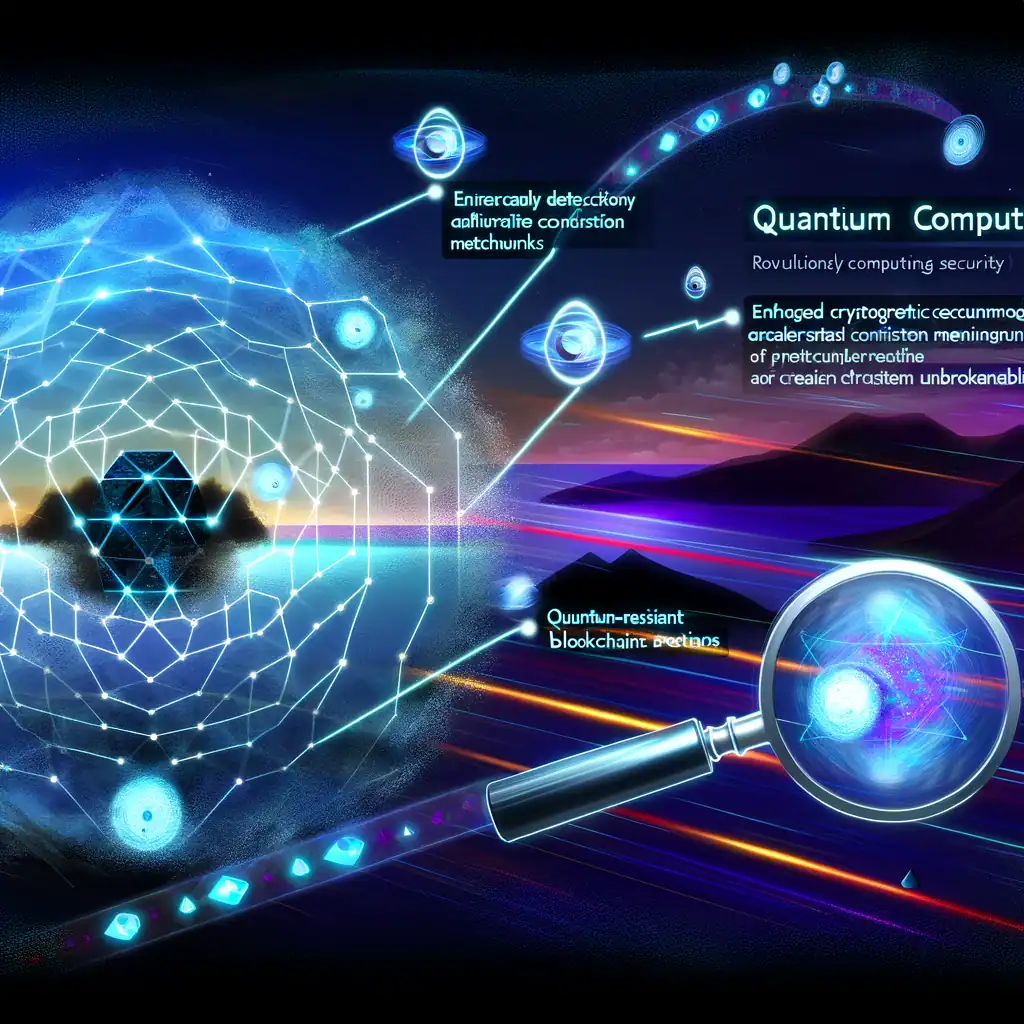
The integration of quantum computing with blockchain technology introduces a new paradigm in digital security.
Quantum computing’s ability to perform complex calculations at high speeds can enhance the cryptographic algorithms that secure blockchain networks. This section explores how quantum computing can fortify blockchain security against both conventional and emerging threats.
Enhancing Cryptographic Algorithms
Quantum computing has the potential to strengthen cryptographic algorithms used in blockchain technology. Current encryption methods, while robust against classical computing attacks, may become vulnerable to quantum-powered decryption. Advanced quantum algorithms can break widely used encryption schemes. Shor’s algorithm, for example, can break encryption like RSA and ECC. These schemes secure most blockchain platforms.
Quantum-Resistant Blockchain
Developing quantum-resistant blockchains involves creating new cryptographic protocols immune to quantum computing attacks. This includes post-quantum cryptography (PQC). PQC relies on mathematical problems that even quantum computers find challenging to solve. Implementing PQC within blockchain networks ensures their security against both classical and quantum threats.
Quantum Key Distribution for Blockchain
Quantum key distribution (QKD) is a method that uses the principles of quantum mechanics to secure communication channels. In the context of blockchain, QKD can secure the transmission of encryption keys over a network. This makes it virtually impossible for eavesdroppers to intercept without detection. This enhances the security of blockchain networks, particularly in applications requiring high levels of confidentiality.
The Challenge of Scalability and Energy Consumption
While quantum computing offers significant advantages, it also faces challenges, including scalability and energy consumption. Quantum computers require extremely low temperatures to operate, leading to high energy demands.

Moreover, scaling quantum computers to handle large blockchain networks poses technical challenges. This section discusses potential solutions and ongoing research aimed at overcoming these obstacles.
Quantum Computing’s Impact on Smart Contracts
Smart contracts are self-executing contracts with the terms of the agreement directly written into code. Quantum computing can enhance the complexity and security of smart contracts, enabling more sophisticated and secure applications on blockchain platforms. This could revolutionize industries such as finance, real estate, and supply chain management.
Future Perspectives: The Road Ahead for Quantum Computing and Blockchain

The integration of quantum computing with blockchain technology is still in its early stages, but its potential is immense.As research progresses, we can expect to see more robust, secure, and efficient blockchain networks capable of resisting the most sophisticated cyber-attacks. This concluding section reflects on the future possibilities and challenges that lie ahead in this exciting field.
FAQs
How does quantum computing enhance blockchain security?
Quantum computing enhances blockchain security through its ability to process complex calculations at incredibly high speeds. These speeds are far beyond the capabilities of classical computers. This computational power can be applied to strengthen cryptographic algorithms that secure blockchain networks, making them more resistant to attacks. Furthermore, quantum computing introduces new methodologies for encryption and security. One example is quantum key distribution (QKD). It offers a level of security that is theoretically unbreakable under current understandings of physics. By leveraging these advanced technologies, quantum computing can significantly bolster the resilience of blockchain systems. It enhances protection against both existing threats and potential future threats.
What are quantum-resistant blockchains?
Quantum-resistant blockchains refer to blockchain technologies that are designed to be secure against attacks from quantum computers. These blockchains employ cryptographic algorithms and protocols that are considered to be resistant to the capabilities of quantum computing. This includes the use of post-quantum cryptography (PQC). PQC relies on mathematical problems that are believed to be difficult for quantum computers to solve. The goal of quantum-resistant blockchains is to ensure the long-term security of blockchain transactions and data. This is crucial even in the face of the evolving threat landscape posed by quantum computing.

Can quantum computing break current blockchain encryption?
Quantum computing has the potential to break certain types of encryption commonly used in blockchain technologies. Examples include RSA and elliptic curve cryptography (ECC). These encryption methods rely on mathematical problems that are challenging for classical computers. However, a quantum computer could solve them much more efficiently using algorithms like Shor’s algorithm. The widespread availability of quantum computers powerful enough to break these encryption schemes is not yet a reality. The blockchain community is actively researching and implementing quantum-resistant technologies to mitigate these risks.
How does quantum key distribution work within blockchain?
Quantum key distribution (QKD) within blockchain utilizes the principles of quantum mechanics to securely distribute encryption keys across a network. In QKD, a sender encodes the encryption key onto quantum states of particles, such as photons. The sender then transmits them to the receiver. Any attempt at eavesdropping on this communication disturbs these quantum states in a detectable manner. This disturbance ensures the integrity of the key exchange. It also guarantees the confidentiality of the key exchange. By integrating QKD into blockchain systems, communications and transactions become significantly more secure. This integration provides a level of security that is theoretically immune to interception or compromise.
What challenges does quantum computing face in blockchain integration?
Integrating quantum computing into blockchain faces several challenges, including scalability, energy consumption, and technological maturity. Quantum computers require extremely low temperatures to function and currently operate on a much smaller scale compared to classical computers. The energy requirements and technical complexity of scaling up quantum computing resources to support large blockchain networks are significant obstacles. Additionally, developing quantum-resistant cryptographic algorithms requires extensive research. Their integration into existing blockchain architectures is crucial to ensure compatibility and security.
How will quantum computing affect smart contracts?
Quantum computing is expected to significantly impact smart contracts by enhancing their complexity and security. The computational power of quantum computing could enable the execution of more sophisticated smart contracts. These smart contracts can perform complex calculations and analyses in real-time. This capability broadens the range of possible applications. Additionally, the integration of quantum-resistant encryption methods within smart contracts can enhance their security. This integration makes them more resilient against potential quantum computing threats. This could lead to the development of more secure dApps in various industries. These industries include finance, real estate, and supply chain management.
Conclusion
The fusion of quantum computing and blockchain technology heralds a new era in digital security.
Enhancing cryptographic algorithms is part of this approach. It involves developing quantum-resistant blockchains. Communications are secured with quantum key distribution. This innovative approach promises to safeguard digital assets against emerging threats.
Despite challenges such as scalability and energy consumption, the potential of quantum computing blockchain security to revolutionize industries is undeniable. As we venture into this uncharted territory, the future of secure digital transactions looks brighter than ever.
Discover more from Financial Freedom with Sakkemoto
Subscribe to get the latest posts sent to your email.
The discussion on challenges, such as scalability and energy consumption, adds depth to the analysis, acknowledging the practical hurdles that need to be overcome for widespread adoption.🤝👏
This blog is a beacon of positivity amidst the often gloomy news. Thank you for this light!
Thank you for your uplifting comment! We’re delighted to know that our blog brings positivity to your day. Quantum computing’s impact on blockchain security is indeed revolutionary, and we’re excited to explore more cutting-edge topics with our readers. Stay inspired and keep visiting for more enlightening content!
Your blog is a testament to your dedication to your craft. Your commitment to excellence is evident in every aspect of your writing. Thank you for being such a positive influence in the online community.
Thank you, Martin, for your kind and encouraging words! We’re delighted to hear that you appreciate our dedication and commitment to excellence. It’s our goal to provide valuable and insightful content on cutting-edge topics like quantum computing and blockchain security. Your support means a lot to us. Stay tuned for more great posts!
Hi i think that i saw you visited my web site thus i came to Return the favore I am attempting to find things to improve my web siteI suppose its ok to use some of your ideas
Hi Agustin, thank you for visiting our site! We’re glad you found our content on quantum computing and blockchain security interesting. Feel free to use some of our ideas to improve your website. If you have any questions or need further inspiration, don’t hesitate to reach out. Happy blogging!
[…] in emerging technologies such as quantum computing and biotechnology offers a promising avenue for substantial long-term growth. These sectors are not […]
[…] you’re still with me, let’s get real. Some months are dry. Algorithms change. Products go out of stock. There will be moments when you wonder, Is this really working? My […]